
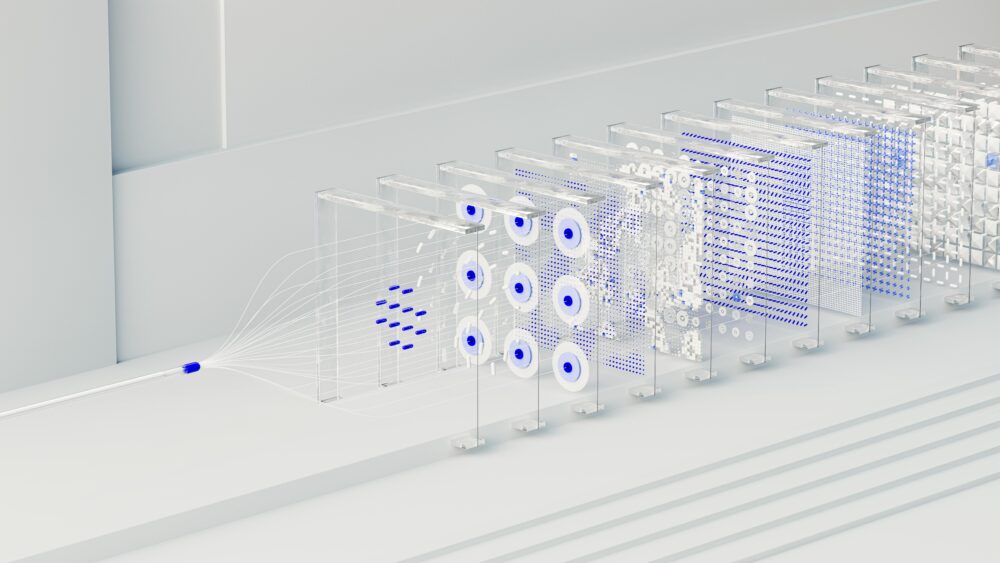
Edge AI brings artificial intelligence directly to local devices, reducing latency and improving privacy. This technology is revolutionizing sectors like automotive, healthcare, and IoT, promising a more efficient and secure future.
Edge AI represents one of the most revolutionary paradigms in the evolution of artificial intelligence, shifting processing from centralized data centers directly to peripheral devices. This transformation is redefining how we conceive AI, bringing intelligence and decision-making autonomy to where action actually happens.
What is Edge AI
Edge AI, or artificial intelligence at the network’s edge, consists of executing machine learning algorithms directly on local devices such as smartphones, IoT sensors, security cameras, autonomous vehicles, and industrial devices. Instead of sending data to the cloud for processing, Edge AI processes information in real-time on the device itself.
This distributed architecture offers significant advantages in terms of latency, privacy, energy efficiency, and reliability, opening new application possibilities previously unthinkable.
Key Advantages of Edge AI
- Ultra-Low Latency: Local processing eliminates cloud transmission times, enabling millisecond responses critical for real-time applications
- Privacy and Security: Sensitive data remains on the device, reducing breach risks during transmission
- Operational Autonomy: Independent operation from internet connectivity, ensuring continuity even offline
- Cost Efficiency: Reduction of bandwidth and cloud storage costs through local processing
- Intelligent Scalability: Distribution of computational load across thousands of edge devices
Transformative Applications
In the automotive sector, Edge AI enables autonomous vehicles capable of making critical safety decisions in milliseconds, analyzing real-time video streams from cameras and sensor data without depending on connectivity.
In healthcare, intelligent medical devices can continuously monitor vital parameters, detect anomalies, and alert doctors instantly, ensuring timely interventions even in remote areas.
Industry 4.0 leverages Edge AI for predictive maintenance, automated quality control, and production process optimization, reducing downtime and improving operational efficiency.
Challenges and Future Prospects
Despite its revolutionary potential, Edge AI faces significant challenges. Hardware limitations of edge devices require optimized algorithms and compressed models. Distributed management of thousands of AI devices presents unprecedented operational complexities.
The future will see evolution toward increasingly sophisticated hybrid cloud-edge architectures, where local intelligence and centralized computation integrate seamlessly. The emergence of specialized chips for Edge AI and interoperability standards promises to democratize this technology, making it accessible to sectors and applications unthinkable today.
Edge AI is not just a technological trend, but a paradigm shift that will bring ubiquitous, invisible artificial intelligence deeply integrated into the fabric of our daily lives.