
No biometric face-identification project appears to be running at the genocide archives in Rwanda or Cambodia. The one documented case concerns the Holocaust, via the From Numbers to Names platform. Comparing the three archives reveals three different regimes for handling a victim’s face — and none of them is neutral.
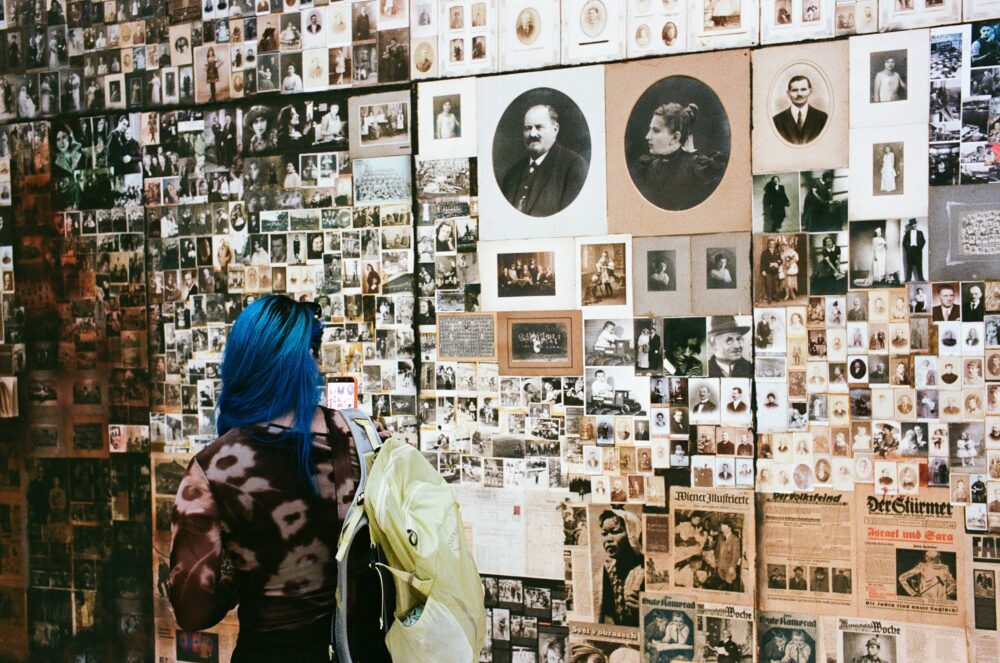
In 2016 a Google software engineer named Daniel Patt visited the POLIN museum in Warsaw. He looked at the photographs on the walls: faces of Polish Jews, photographed before and during the Holocaust, almost all of them nameless. He thought his grandparents might be among them, and that he had no way of finding out. That visit produced From Numbers to Names, a non-profit platform that applies facial recognition to Holocaust photographic archives.
The artificial intelligence component is exactly what you would expect, and it is worth naming precisely, because everything hinges on it: a machine learning model trained to turn a face into a numerical representation — a vector of features — and to measure the distance between that vector and those of other faces. A user uploads a family photograph; the system searches the archive and returns the ten best possible matches. It does not say who the person is. It says: here are ten faces that, by a geometric metric, resemble yours. By June 2022 the project had analysed almost half a million photographs containing roughly two million faces, with a backlog of identifications still awaiting manual verification; Patt said at the time he was working to gain access to a further 700,000 pre-war and wartime images. Some identifications have appeared on the website of the United States Holocaust Memorial Museum. One confirmed case involves a photograph attributed to the mother of Geddy Lee, bassist of the Canadian band Rush: her son recognised the shot as taken at the Bergen-Belsen displaced persons camp.
What does not exist
This needs saying up front, because the opposite belief circulates: there is no evidence of any comparable project running on the genocide archives of Rwanda or Cambodia. Neither the Tuol Sleng Genocide Museum, nor the Documentation Center of Cambodia, nor the Genocide Archive of Rwanda or the Kigali Genocide Memorial appears to use biometric software to attach names to victims’ faces. The absence should be treated as what it is — not found, rather than proven impossible — but it is solid enough to dismantle the story of a global race to automate the identification of genocide victims, with museums in the global South leading the charge.
The interesting historical comparison still exists. It just isn’t “Rwanda versus Cambodia, with AI”. It is a three-way comparison about what is actually done to the photographed face of a murdered person.
Three regimes of the face
The first regime is N2N’s: the face as searchable biometric data. The archive becomes a vector space, resemblance becomes a distance, and the output is a ranked list of hypotheses. Its strength is that it does not claim to decide — it hands the final step to a human. That is also its weak point. No available source reports precision rates, false-positive rates or independent validation of the system. We know it proposes candidates and that confirmations are manual; we do not know how many proposals are wrong, nor what happens when a family accepts as true a resemblance the software merely ranked third.
The second regime is Rwandan: digitisation and named records, without biometrics. The Genocide Archive of Rwanda, run with Aegis Trust at the Kigali Genocide Memorial, went online in December 2010, making video testimonies, archival photographs and documents accessible remotely. It has a dedicated category for Victim Identity Photographs — official ID portraits used for identification — and a victims’ database. The memorial, which is also the burial place of 250,000 victims of the genocide against the Tutsi, holds identity cards, personal belongings and photographs donated by families. Here the name is not inferred by a model: it comes from whoever brings the photograph, from the document, from the testimony. The chain of attribution is human and traceable.
The third regime is Cambodian, and it has nothing to do with identification. The archive of the Tuol Sleng Genocide Museum — the Khmer Rouge S-21 prison, inscribed on UNESCO’s Memory of the World register — holds photographs of more than 5,000 prisoners, out of a total detainee count that sources put anywhere between just over fourteen thousand and around seventeen thousand. It also holds “confessions” extracted under torture and biographical files on prisoners and guards. A UNESCO project with the Cambodian Ministry of Culture and Fine Arts, funded by the Korean development agency KOICA, has digitised nearly half a million S-21 documents and modernised the archive storage. Older, non-biometric photographic databases also exist: the Tuol Sleng Image Database of Yale’s Cambodian Genocide Program, and the DC-Cam database covering more than five thousand photographs.
The case everybody remembers wrongly
The recent Cambodian controversy was not about recognition but about intervening in the image. On 9 April 2021 Vice Asia published an interview with the Irish artist Matt Loughrey about his colourisation of S-21 photographs. It emerged that some images had been altered by adding smiles to victims’ faces. On 11 April Vice retracted the article and the photographs, admitting it had failed to meet its own editorial standards. Cambodian authorities formally demanded the images be withdrawn, calling them an insult to the dead. To be clear: this was conventional digital manipulation, not generative artificial intelligence.
But the episode illuminates the problem that biometrics raises too, better than any privacy argument does. In both cases the victim’s face is treated as workable material: there to give it back an expression, here to extract a vector from it. The intention and the outcome differ — a falsified colourisation helps no one, a correct match returns a name to a family — but the structure of the gesture is the same: someone operates on an image whose subject never consented to its existence. At S-21 the photograph is literally an act of the perpetrator; the mugshot was part of the registration procedure before execution.
What remains to be decided, and who isn’t deciding it
There is a point the public debate has not yet reached, and it concerns not technology but the threshold of certainty. A facial recognition system does not produce identifications: it produces similarity rankings. Turning a ranking into a name is a historiographical act, not a computational one, and it requires an explicit criterion — what evidence is needed beyond resemblance, who decides, what the caption says when confirmation is partial. For the archives discussed here, no public protocol of that kind appears to exist, nor any rule specifically governing biometric use on genocide materials.
This is where the absence of such projects in Rwanda and Cambodia stops looking like backwardness and starts looking like a defensible choice. Where the chain of attribution runs through a family, a document, a survivor, an error has someone’s name attached to it. Where it runs through a model, an error has a metric. And a metric cannot be called to answer to anyone.