
In Ecuador’s shrimp ponds, feed is dispensed when an underwater microphone hears the animals chewing: passive acoustics plus adaptive algorithms, not a model that recognises individual shrimp. Field data from 639 ponds show it works well with extruded feed and badly with traditional pellets. In Vietnam and the rest of Asia, this is still research, not deployment.
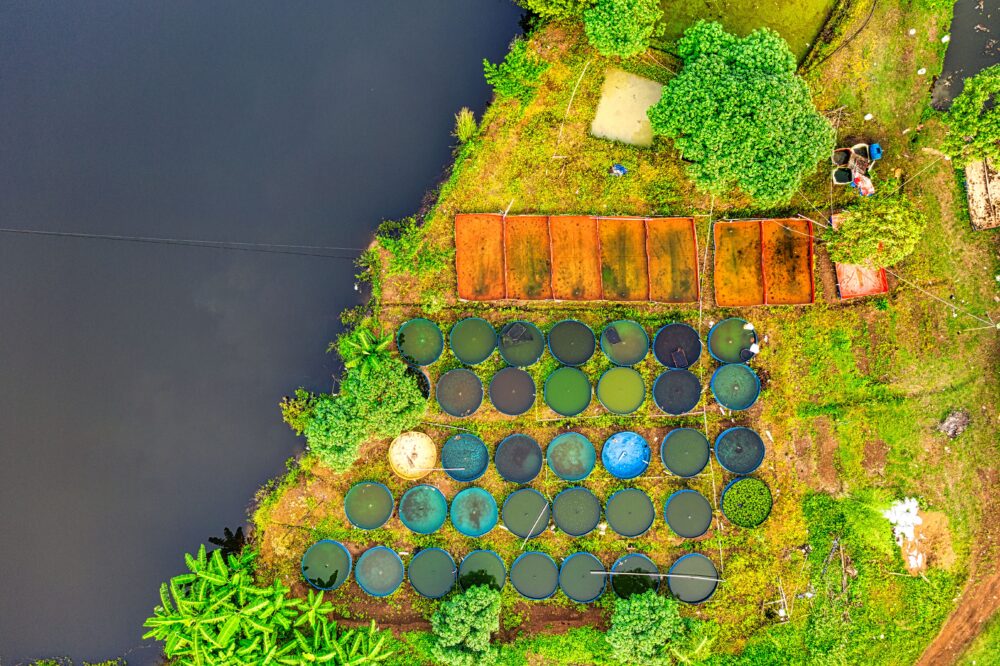
In an eight-hectare pond in Guayas province, Ecuador, a plastic hopper full of feed hangs above the water. A few metres below sits a hydrophone — an underwater microphone. When shrimp start chewing the pellets, their mandibles produce a series of very short clicks in a recognisable frequency band. The system hears them, infers that the animals are feeding, and keeps the dispenser running. When the clicks thin out, it stops. No operator decides, and there is no schedule: there is a feedback loop closed on the sound of chewing.
The computational component here is more modest than precision-aquaculture marketing suggests, and it is worth saying so immediately. The commercial reference is the SF200 Sound Feeding System from AQ1 Systems, a Tasmanian company that since around 2022 has been owned by the Danish group BioMar — one of the world’s largest aquaculture feed producers, with 17 feed plants supplying roughly 90 countries, led by CEO Carlos Diaz. The system works on a continuous audio stream: it filters the signal to separate feeding clicks from background noise (aerators, rain, fish, wave action) and applies what the company calls Adaptive Feeding Algorithms, which modulate the dispensing rate according to the intensity of the detected signal. This is classification and control on an acoustic signal, with parameters that update over time. It is not a model that recognises an individual shrimp, it does not count animals, and it does not estimate biomass. Anyone describing these installations as “artificial intelligence watching the crustaceans” is describing something else.
Why feeding is the right place to put the sensor
Feed is the dominant cost in shrimp farming. Industry estimates range from the 50-60% cited by Andrew Campbell, AQ1’s chief executive, to the 60-70% appearing in an abstract presented by the company’s Asian division at the World Aquaculture Society. Both figures come from parties selling the solution, and should be read with that in mind; but even at the low end, anything that improves feed efficiency outweighs any other process optimisation.
The difficulty is that with shrimp you cannot see anything. In a five- or ten-hectare earthen pond the water is turbid by design: it is green water, full of phytoplankton, and that is part of the production system. The animals stay on the bottom. Cameras, which in finfish farming allow operators to watch feeding response directly, are useless here. For decades the answer was empirical: sampling trays, ration tables, operator experience. In Ecuador, until around 2016, the norm was manual feeding once or twice a day. Passive acoustics is interesting precisely because it sidesteps visibility: sound travels through turbid water as it does through clear water.
The number that breaks the simple story
There is a large field study covering 639 commercial ponds of 8-12 hectares in Guayas province between 2018 and 2020, using 35%-protein feeds and comparing three strategies: manual, timer-based, and acoustic. The widely quoted result is the good one: extruded feed combined with an acoustic feeder produced a feed conversion ratio (FCR) of 1.67, growth of 1.72 grams per week and a yield of 6,327 pounds per hectare — 22% higher than extruded feed delivered by other means. The original data come from an article by Molina published in Revista Aquacultura, the journal of Ecuador’s Cámara Nacional de Acuacultura, in October 2020.
The more interesting result is the other one. In the same sample, acoustics paired with traditional pellets produced the worst FCR of any combination tested: 1.96, against 1.65 for a plain timer using the same pellets. In other words, adding the sensor to the wrong feed type made efficiency worse than a system that listens to nothing and dispenses on a fixed clock.
The sensor does not measure shrimp appetite. It measures a sound correlated with shrimp appetite, and that correlation depends on what they are chewing.
The physical explanation is documented: pellet hardness and texture correlate with the acoustic intensity detected (Peixoto et al., 2020). Extruded feed is harder and denser, so it produces a more energetic click that stands out from background noise. Traditional pellets, more friable, produce a weak signal. A system that modulates dispensing on a weak, ambiguous signal makes worse decisions than a system that makes none. It is a textbook case of what happens when you close a feedback loop on a noisy measurement: automation amplifies the error rather than correcting it.
The installation constraint nobody mentions
Then there is an operational detail that says a lot about practical limits. To maintain a clean acoustic signal, the recommended maximum is three feeders per hydrophone. That means sensor density is not trivial, and the signal-to-noise ratio dictates a specific physical layout: the more feeding points per sensor, the harder it becomes to tell where the sound is coming from. This is technology that installs well in large, extensive, low-density ponds — in Ecuador that means units above 5 hectares and fewer than 35 animals per square metre — and considerably less well in intensive, crowded systems with many aerators running.
The efficacy evidence should also be taken for what it is. The Ecuadorian data are observational, collected on working commercial farms: not a randomised trial, and pond-to-pond variability is enormous. At least one study pairing passive acoustic monitoring with a feed effector found no statistically significant differences in intake, FCR or survival. The independent literature on passive acoustic monitoring applied to Litopenaeus vannamei — the Pacific white shrimp, the dominant farmed species worldwide — is still being built, and includes work on detecting feeding activity in high-density, low-visibility ponds.
Where the technology has actually landed
Here a common assumption needs correcting. The geography of this story is not Asia versus Latin America: it is Ecuador, full stop. According to Campbell, speaking at the Global Shrimp Forum in September 2025, the company’s sound technology accounts for more than 40,000 feeders in operation across more than 15 countries, and Ecuador leads not only in installed base but in what he called the culture of feeding automation. Saudi Arabia, Mexico, Honduras and Nicaragua follow. In Asia, says the same executive from the company selling the systems, “it is still relatively early”: the phase is farmer training.
Vietnam, despite being one of the world’s largest shrimp producers, appears in this picture as research ground, not market. There is a documented integrated system combining feeding acoustics with water-quality monitoring, developed within a project linked to the ASEAN IVO programme using an Aquarian H1a hydrophone and tested in one commercial pond. A pilot, with a publication. There are no public figures on how many acoustic systems are installed in the country, which companies use them, or what production results they have achieved. Anyone writing that Vietnamese farms are adopting acoustics the way Ecuadorian ones have is extrapolating, not reporting.
One last thing is worth noting, and it concerns who owns the sensor. AQ1 supplies feeding-control and sizing solutions for 25 species, and it was acquired by BioMar, which makes the feed. The company selling the pellets now also controls the device that decides how many pellets to dispense — and the field data say the device works well with only one feed type, extruded, which is more expensive to produce than traditional pellets. This is not necessarily a problem: extruded feed is objectively better suited to the application, and the physics of the click is what it is. But it is the kind of alignment worth holding in mind when reading FCR numbers, particularly because almost all of them come from the same supply chain.