
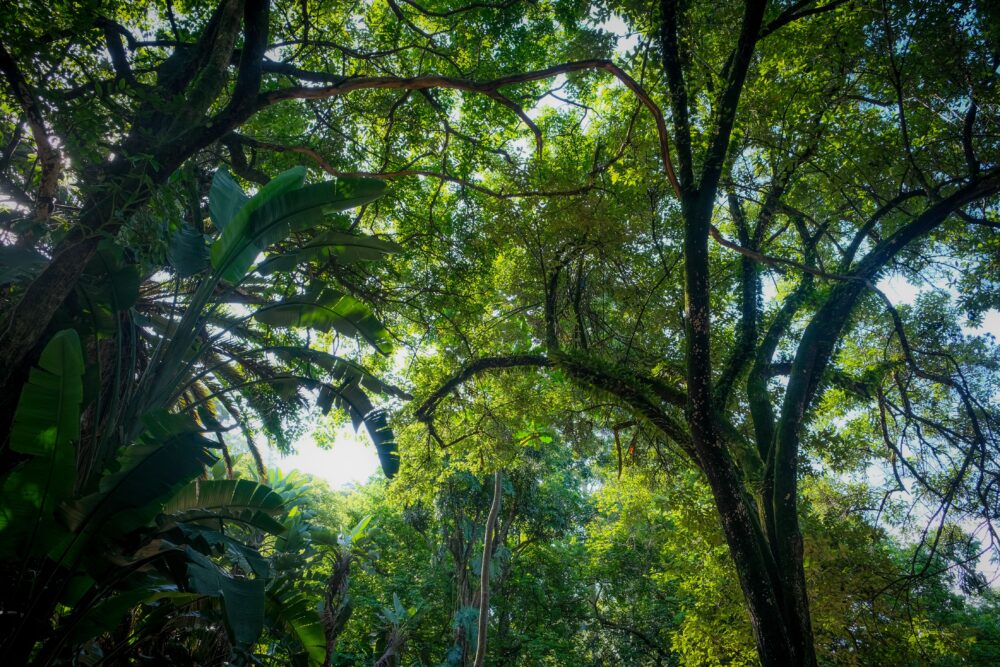
Rainforest Connection’s Guardian devices are solar-powered boxes with microphones placed high in the canopy: a machine learning model classifies the audio and pushes an alert to a ranger’s phone. The public record describes the sensor and the classifier well, and says far less about who receives the alert and what happens next. Detection itself isn’t a solved problem either.
Picture a box roughly the size of a hardback, strapped twenty or thirty metres up in the crown of a tree, with petal-shaped solar panels angled to catch the scraps of light that make it through the canopy. In the original design, inside was a second-hand smartphone. Outside, a microphone. The box is called a Guardian, it is built by Rainforest Connection — a non-profit founded in 2013 by Topher White, who served as its chief executive until 2022 — and its job is to listen to the forest around the clock.
This is precisely where artificial intelligence enters the story: the captured audio is sent over cellular networks to cloud infrastructure, where machine learning models trained on labelled recordings try to isolate, within a soundscape of cicadas, rain, birds and wind, a few specific acoustic signatures — a chainsaw, a vehicle engine, a gunshot. When the classifier flags one, a notification goes to the phone of whoever patrols the area. The system sees nothing: no satellites, no imagery. It hears, and tries to name what it hears.
What is actually on the record
It is worth being precise about where these devices have been publicly described, because the project’s geography gets flattened in retelling. In Ecuador, the documented sites are the Cerro Blanco Reserve near Guayaquil, run with Fundación Pro-Bosque, and the Mashpi Reserve in the Chocó, with Fundación Futuro. The first is tropical dry forest, the second cloud forest. Neither is Amazon rainforest, even though the organisation’s name and the imagery that travels with it invite that assumption.
In Peru the publicly cited site is the Tambopata National Reserve in the country’s south-east, where the devices have been linked to the arrest of loggers; at the time, in 2018, the organisation described around a hundred units in Peru and a presence in nine other countries. The first Amazonian deployments to get international press coverage were in Brazil instead: the Tembé people, in the state of Pará.
On overall scale, the available figures are self-reported and do not agree with each other. A 2021 announcement tied to the Huawei partnership refers to twenty-two sites in eighteen countries; elsewhere the claim is fourteen countries across five continents; the founder’s own profile says more than thirty countries. These are communications numbers. They are not a registry.
And there is a point better stated than buried: almost all the public material on Peru and Ecuador clusters between 2018 and 2021. Whether those particular sensors are switched on today, in 2025, is not something the available sources let you assume. The technology partnerships, by contrast, are traceable and recent: the GSMA GLOMO award to the “Nature Guardian” project with Huawei on 30 June 2021, the extension of the Infineon collaboration in January 2023 to add CO2 sensing, work with Hitachi Digital Services, support from Google.org, and the Arbimon platform for bioacoustic analysis.
The temptation to declare the easy part solved
There is a familiar framing around projects like this: the recognition works, the problem is that nobody shows up. It is a seductive thesis, because it moves the blame from engineering to politics and because it matches what we know about plenty of other alerting systems. The trouble is that in forest acoustics it is not demonstrated — and the technical side is less settled than the framing implies.
A study on arXiv working with annotated data supplied by Rainforest Connection identifies two main obstacles for these classifiers. The first is the domain gap: the large audio datasets available for training sound-recognition models are made of urban and domestic sounds, recorded with different equipment under conditions that look nothing like an Amazonian canopy. A model that learned what a chainsaw is from clips uploaded to the internet is not necessarily learning the thing it will have to recognise at thirty metres, in the rain, mixed into an insect chorus that at certain hours saturates whole frequency bands. The second obstacle is the scarcity of labelled data: annotating hours of forest audio is slow, expensive and requires expertise.
That has a concrete operational consequence. A classifier with a low error rate in the lab can still, across a continuous stream running for months, generate enough false positives to erode the trust of the people receiving the notifications. And an alert nobody trusts is, in practice, an alert nobody forwards. This is not a last-mile problem: it is detection contaminating response.
Who arrives, and when
Here we reach the least documented part, and the honest thing is to say so. Public sources describe the technical architecture in detail — hardware, cloud, models, app — and turn vague at exactly the point where a reader wants more: who the receiving entity is, under what mandate, with what resources, and with what outcome. The press has reported arrests connected to Tambopata, but within the accessible material there are no figures on cases opened, penalties issued or equipment seized traceable to acoustic alerts. Nor is there a controlled impact evaluation of the system.
One thing can be said with certainty: whoever arrives is not always the state. In the Brazilian Amazon there are Indigenous surveillance groups patrolling their own territories, often armed, under real risk — Paulo Paulino Guajajara, of the Guardians of the Forest in Maranhão, was killed in an ambush in November 2019. These are separate actors with separate operational chains from any sensor supplier, and they should be kept separate in the telling. But they are a reminder of something technological language tends to obscure: the final line of an alerting system is not a push notification. It is a person walking toward the sound of a chainsaw in the dark.
Bioacoustics does other things too
There is a use of this same infrastructure that gets far less attention and may be the more promising one. A paper published in 2023 in Ecological Informatics shows how acoustic monitoring can be used to direct patrols toward offences other than logging — the presence of cattle inside protected areas, for instance. A herd does not sound like a chainsaw, but it is just as recognisable to a model trained to look for it, and it is a far more persistent indicator of encroachment.
The conceptual difference matters. A chainsaw is an event: it lasts minutes, it demands an immediate response, and a three-hour delay makes the alert worthless. Cattle are a state: they persist, they can be verified unhurriedly, and they generate evidence that still works weeks later. An acoustic system judged solely on whether it can get someone to the falling tree in time is being judged on the task it is least likely to win. Judged instead as an instrument that describes, month after month, where illegal pressure concentrates and how it moves, it becomes something else — less dramatic to narrate, much harder to dismantle in a courtroom or a planning meeting.
Perhaps the most instructive fact about Rainforest Connection has nothing to do with forests. It is that we know, in detail, the names of the cloud partners and the history of the recycled smartphones, and almost nothing about what happens in the ninety minutes after a ranger’s phone buzzes. That is an asymmetry of documentation before it is one of engineering. And it says something about which half of the system somebody had an interest in measuring.