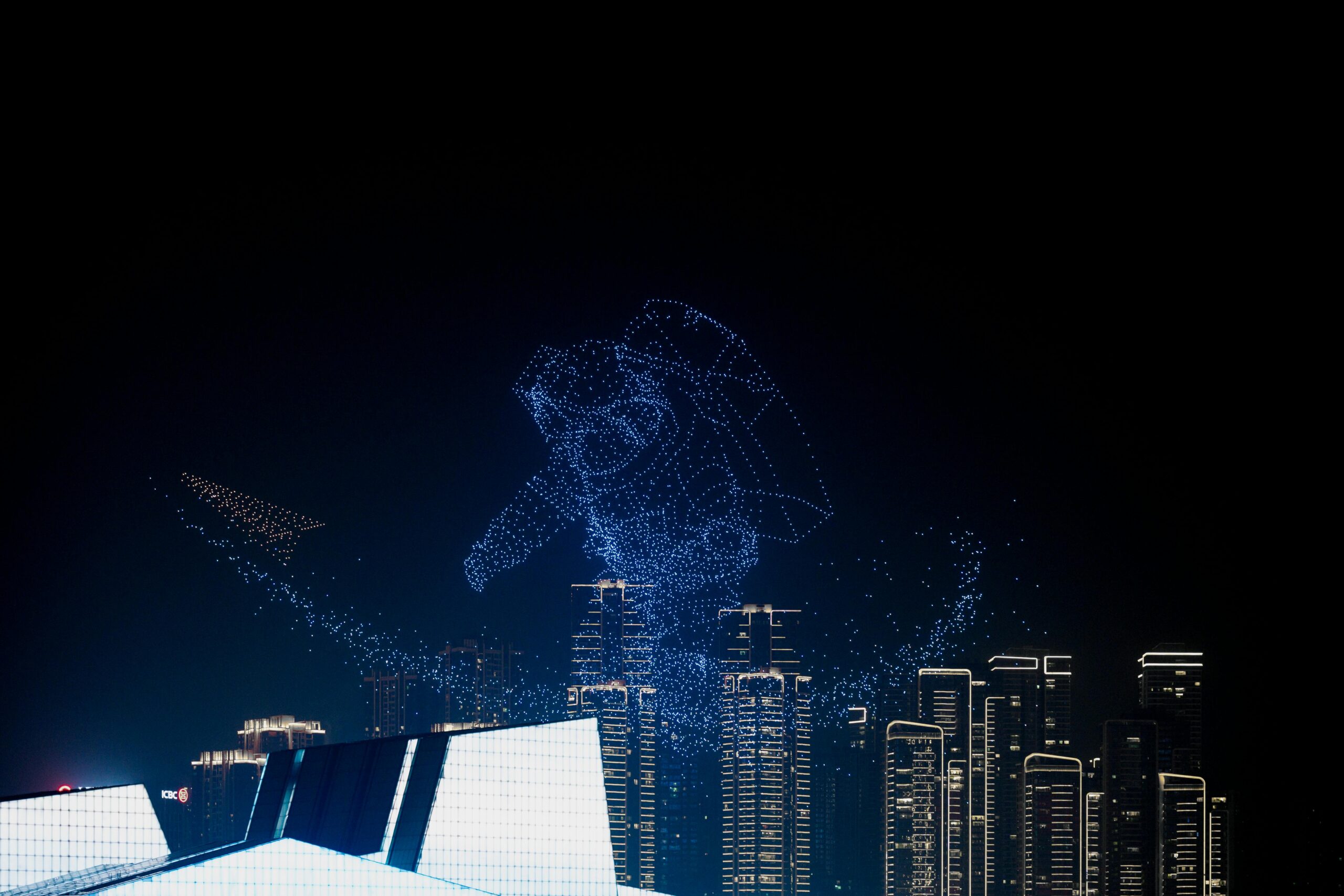
Swarm Intelligence represents a new AI frontier inspired by the collaborative behavior of swarms, flocks, and colonies. This technology promises to revolutionize sectors from logistics to robotics through intelligent collective decision-making.
Imagine thousands of bees working together to build a perfect hive, or a flock of birds moving in complex formations without a central leader. These natural phenomena have inspired one of the most fascinating frontiers of artificial intelligence: Swarm Intelligence.
Understanding Swarm Intelligence
Swarm Intelligence is an AI paradigm that emulates collective behavior observed in decentralized biological systems. Unlike traditional AI systems that rely on centralized intelligence, swarm AI distributes intelligence among multiple simple entities that interact locally to emerge complex and intelligent behaviors at a global level.
Each individual agent follows relatively simple rules, but the interaction among all agents generates sophisticated patterns and optimal solutions that no single agent could have achieved alone.
How It Works in Practice
Swarm Intelligence algorithms are based on fundamental principles:
- Self-organization: Agents coordinate without centralized control
- Emergence: Complex behaviors emerge from simple interactions
- Stigmergy: Agents communicate by modifying the environment
- Adaptability: The system dynamically adapts to changes
A classic example is the Ant Colony Optimization (ACO) algorithm, where virtual agents search for optimal paths by leaving digital traces that influence other agents’ choices, just like real ants leave pheromone trails.
Revolutionary Applications
Swarm Intelligence is finding extraordinary applications across various sectors. In logistics and transportation, swarm algorithms optimize routing for vehicle and drone fleets, reducing time and costs. In smart cities, intelligent traffic light systems coordinate to optimize traffic flow in real-time.
In robotics, robot swarms collaborate to explore dangerous environments, perform search and rescue operations, or construct complex structures. In industrial optimization, these algorithms solve complex logistical problems, from production scheduling to supply chain management.
Future Advantages and Challenges
Key advantages of Swarm Intelligence include robustness (failure of individual agents doesn’t compromise the system), scalability (easily expandable), and energy efficiency. However, significant challenges remain: difficulty in predicting emergent behaviors, complexity in designing local rules that produce desired global outcomes, and the need for new security frameworks.
As we look to the future, Swarm Intelligence promises to transform how we conceive artificial intelligence, moving us from centralized and rigid systems toward distributed intelligent ecosystems that can adapt, evolve, and solve problems with unprecedented flexibility.