
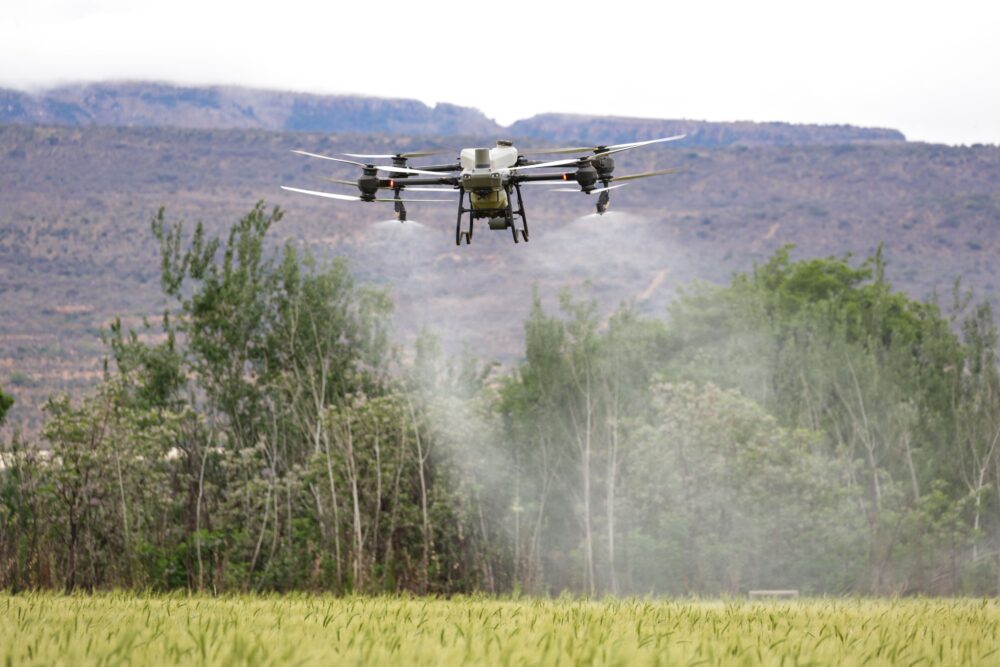
Chinese agricultural drones from DJI Agras and XAG are sold across sub-Saharan Africa, carrying increasingly sophisticated onboard perception and mapping software. But authorised service is concentrated in a few urban hubs and spare parts often ship from outside the continent. A practical buyer’s guide — and an honest account of what the available evidence does not yet support.
Picture the situation, because it is the standard operating scenario for anyone doing drone spraying in sub-Saharan Africa: a DJI Agras T40 over a maize field several hours of dirt road from the nearest city, a 40-kilo tank, a working width of roughly eleven metres. The aircraft does what it was designed to do — follows a field map, holds altitude over uneven terrain, adjusts nozzle flow to ground speed. Then a motor stops responding. At that point the question is no longer technological. It is logistical. Who repairs it? With which part? In how many days?
It is worth being explicit about where the artificial intelligence sits in this story, because most brochures leave it implicit. An agricultural drone of this generation is not a radio-controlled aircraft with a pump bolted on. It carries radar and binocular cameras, runs computer-vision models on board to read terrain profile and obstacles, builds a three-dimensional map of the field and generates its own flight path from it. In some configurations, systems trained on aerial imagery distinguish weed-infested or stressed patches from healthy crop and modulate the dose along the route. This is machine learning driving a machine that weighs tens of kilograms and flies over someone’s head. Almost all the value over a tractor-mounted sprayer lives there.
Which is exactly why maintenance here is a different problem from maintaining a tractor. A diesel engine can be fixed by a good mechanic with compatible parts. A system in which perception, flight control and actuation are coupled through firmware does not tolerate the same approach. A non-original propeller, an ESC — the electronic speed controller governing the motor — with different response curves, a botched sensor calibration, and the control model is now working on inputs that no longer match the physical reality of the aircraft. It does not fail visibly. It degrades.
What is documented, and what is not
A clarification here matters more than any punchy headline. It is documented that Chinese spray drones are sold and used in sub-Saharan Africa: the DJI Agras line — T40, T55, T70P, T100 — is offered by African resellers, and in Kenya the T40 is sold by Drone Space, an operator that also provides training and services. XAG works through a network of authorised distributors and has published an official notice urging buyers to purchase only through authorised channels, flagging that products and components circulate outside them.
What is not documented — at least not by sources I was able to verify — is that Chinese exports of spray drones to Kenya, Zambia or Nigeria have grown by any measurable amount. There is no figure, and not even a confirmed direction of travel. Establishing that would require Chinese customs data or UN Comtrade records under HS heading 8806. Equally, I have not verified either the presence or the absence of authorised DJI or XAG service centres in those three countries. The resellers and repair shops that surface most easily online are South African, which tells you something about online visibility, not necessarily about conditions on the ground.
A geographical note that is not pedantry: Zambia is southern Africa, Nigeria is West Africa. Treating them as “East Africa” puts three different aviation regulators, three customs regimes and three logistics networks that do not talk to each other into the same paragraph. For someone deciding whether to buy an aircraft, that is precisely the difference between an informed decision and a bet.
The questions to ask the seller
Prospective buyers tend to compare specifications: tank capacity, working width, hectares per hour. Those are the wrong numbers to lead with. The useful checklist is about operational continuity:
- Name and street address of the nearest authorised service centre. Not “we cover the region” — an address. Ask the manufacturer for the authorised distributor list; do not infer it from a reseller’s website.
- Which spare parts are physically in stock in-country and which must be imported. Motors, ESCs, propellers, pumps, nozzles, radar modules: these are wear items, not freak failures.
- Who recalibrates the sensors after a replacement, and with what equipment. That step is the difference between a repair and a hazard.
- How firmware updates are handled, and what happens if the machine falls several versions behind while working offline for weeks.
- What voids the warranty. XAG’s notice about unauthorised channels is a clear signal: the manufacturer distinguishes between its own components and components that resemble them.
One reference point exists, though it comes from a different country. A specialist South African repair shop states 5–10 working days for standard jobs — motors, ESCs, gimbals — and 10–15 for complex work such as PCB soldering, liquid damage and rebuilds, counted from quote approval. That is a single operator in a single market, and it proves nothing about Kenya, Tanzania or Uganda. But it sets a realistic order of magnitude: even in the good scenario, with a competent workshop and the part in hand, you are thinking in weeks. Then add transport, customs and an agronomic window that does not wait.
In Kenya, the paperwork comes before the aircraft
There is a further layer, and in Kenya it is explicit. Drone operations fall under the Kenya Civil Aviation Authority and the Civil Aviation (Unmanned Aircraft Systems) Regulations. Agricultural spraying is commercial use: it requires a remote pilot licence, registration of the aircraft and a radio licence. Training must take place at KCAA-accredited Unmanned Training Organizations, and physically bringing a drone into the country to train pilots requires an import permit. The current rules were gazetted after the 2017 RPAS regulations were revoked, with lower fees, and precision agriculture was listed among the anticipated uses.
Whether a specific spraying approval is required on top of licence and registration is a question to put directly to KCAA. A reseller’s website is not a source for that. For Zambia and Nigeria, the respective regulators’ frameworks need checking case by case — nothing here transfers across borders.
The consequence almost nobody budgets for
The way this technology gets bought is shifting accordingly, and the direction is interesting. Commercial growers increasingly do not buy the drone at all: they buy treated hectares from a service provider who keeps spare airframes and absorbs the downtime risk. It is the same logic that turned software into a subscription, applied to a physical object.
And here is the less obvious part. In that model, the service provider accumulates something no individual owner ever would: flight logs and field maps from dozens of farms, season after season. Those are exactly the data on which weed-detection and crop-stress models are trained. A failed motor is a spare-parts problem. The question no purchase contract addresses is who ends up owning that accumulated dataset — and whether the farmer who generated it, by having someone fly over his own fields, will ever see it again.