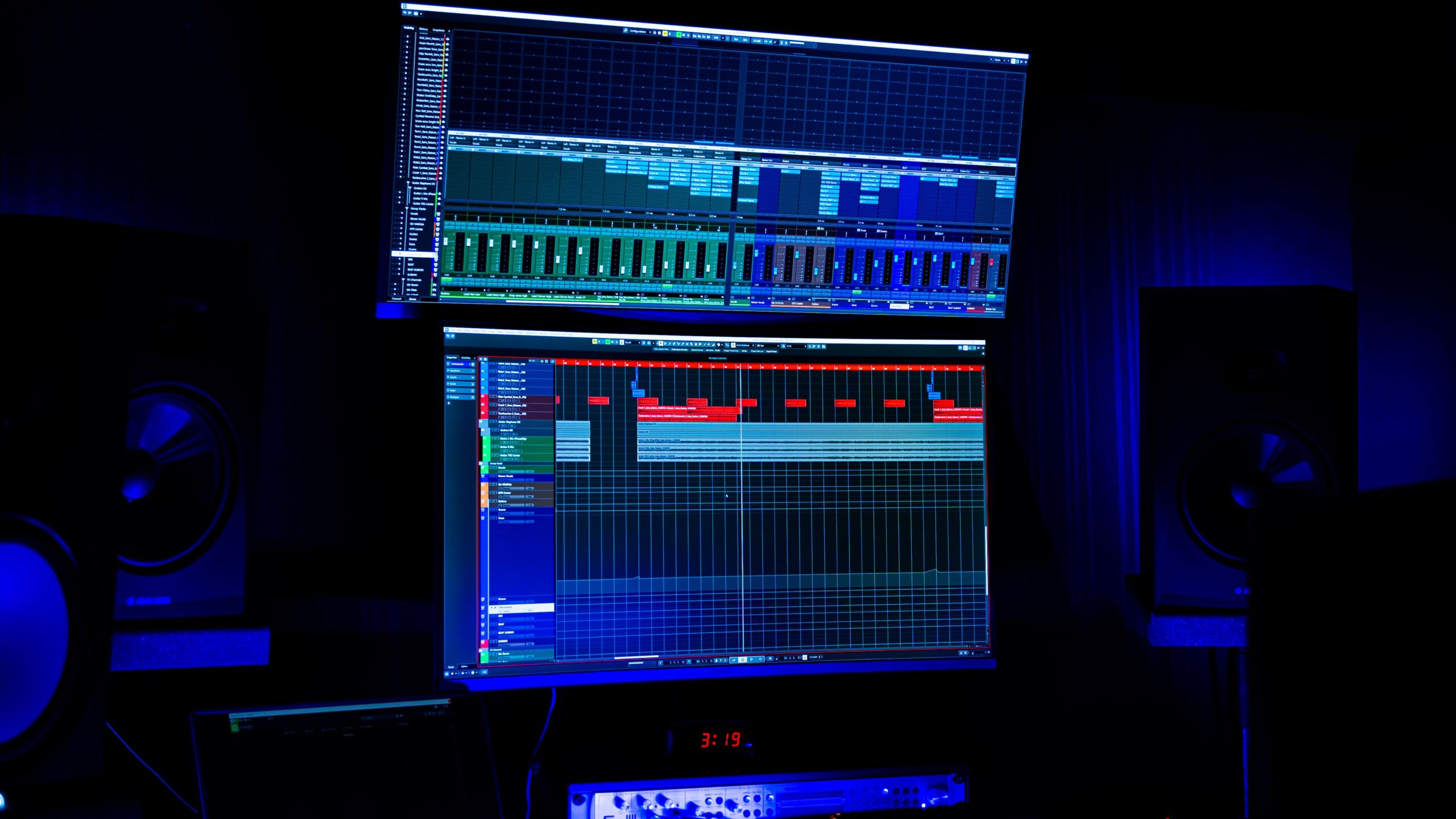
From automatic composition to personalized music production, AI is transforming how we create, distribute, and experience music. A journey through creative opportunities and ethical challenges for artists and the recording industry.
Music, long considered one of the most profoundly human forms of expression, is undergoing a radical transformation thanks to artificial intelligence. Increasingly sophisticated algorithms can now compose melodies, generate complex arrangements, and even mimic the style of famous artists, opening up scenarios that until recently belonged to science fiction.
Platforms like AIVA, Amper Music, and Soundraw now allow anyone to generate original musical tracks in minutes, simply by specifying genre, mood, and desired duration. These technologies don’t necessarily replace musicians but become co-creation tools that accelerate the compositional process and democratize access to professional music production.
Algorithmic Composition: Creativity or Replication?
One of the most debated aspects concerns the creative nature of AI music. Deep learning models are trained on vast databases of existing songs, learning harmonic, rhythmic, and melodic patterns. The result is often surprisingly convincing, but it raises fundamental questions:
- Can AI truly “create,” or does it merely recombine learned elements?
- Who holds copyright on an algorithmically generated song?
- How do we protect artists whose style is “cloned” without consent?
Cases like that of Holly Herndon, who trained an AI model on her own voice to create a digital twin called Holly+, show how some artists are consciously embracing these technologies, transforming them into expressive tools rather than threats.
Personalization and New Listening Experiences
Beyond composition, AI is also revolutionizing how we consume music. Recommendation algorithms from Spotify and other streaming platforms analyze millions of behavioral data points to create hyper-personalized playlists, but the future promises even more immersive experiences: music generated in real-time that adapts to the listener’s mood, detected through wearables or biometric sensors.
Experimental projects are already exploring dynamic soundtracks for video games and wellness applications, where the musical track instantly changes based on the user’s stress or concentration levels, creating a continuous dialogue between technology and human emotional state.
The Recording Industry Facing Change
Record labels are also adopting AI for production purposes: automated mastering, audio track separation, restoration of historical recordings, and even predicting commercial hits through predictive analysis of musical trends. Major labels like Universal and Warner are investing in tech startups to keep pace with this innovation race.
However, strong union and artistic resistance remains. Musicians and industry associations are demanding clear regulations to ensure transparency about AI use in creative processes and fair compensation when technologies rely on analyzing copyrighted works.
Toward Creative Coexistence
The future of music will likely not be a replacement of the human artist, but a hybrid collaboration. Artificial intelligence could handle technical and repetitive aspects, leaving humans the task of infusing meaning, emotion, and cultural context. The main challenge will be building a regulatory and ethical ecosystem capable of valuing this synergy, while protecting the uniqueness of human artistic expression in an increasingly algorithmic era.