
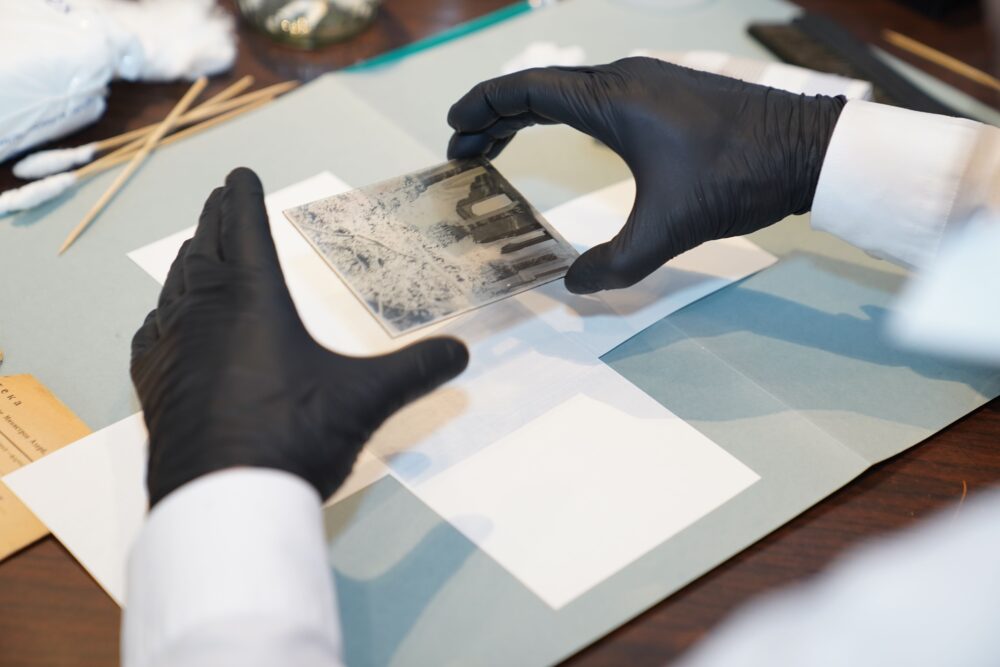
Italy’s publicly funded digitisation campaigns for historic photo archives are wrapping up and the results are going online. But at the Alinari archive in Florence and the Publifoto archive owned by Intesa Sanpaolo, the documented restoration work is physical — conservators cleaning glass plates by hand — not algorithmic. That choice runs directly against where automated image restoration software is heading, and the reasoning behind it is worth unpacking.
A gelatin silver glass plate from the late nineteenth century weighs almost nothing, breaks at a touch, and carries its entire biography on its surface: a century of warehouse dust, moisture halos, emulsion lifting, scratches from decades of handling. When it goes under the scanner, whoever is digitising it faces a choice that looks technical and is in fact cultural: should the defect be removed, or recorded?
It is a question that now has an instant software answer. Machine learning models for image restoration — networks trained on vast collections of paired “degraded / clean” images — do exactly this job: feed them a noisy, scratched, faded scan and they output a version that looks intact. Denoising, inpainting of missing areas, super-resolution, face reconstruction, colourisation: all one click away, built into consumer tools and cloud services. Applied in batch to an archive of tens of thousands of negatives, the temptation is obvious.
The interesting thing about this case study is that the two most substantial Italian photographic archives to have worked on their negatives in recent years did not take it. And the reasoning deserves more attention than the demo reels of automated reconstruction.
What actually happened in Tuscany
Some context for readers outside Italy. Alinari, founded in Florence in the nineteenth century, is one of the oldest photographic firms in the world and its archive is a national reference point for images of Italian art, architecture and daily life. The regional government of Tuscany bought it in December 2019 and in July 2020 established FAF Toscana – Fondazione Alinari per la Fotografia. When the acquisition was completed in December 2020, the digital archive of over 250,000 images, the databases, trademarks and usage rights all passed into public ownership.
Then came the money. Italy’s National Recovery and Resilience Plan — the country’s share of the EU post-pandemic recovery fund — includes a culture strand. A 2022 ministerial decree distributed 70 million euros among Italy’s regions and autonomous provinces for digitising locally held heritage; Tuscany received 4.5 million. The regional plan, approved in April 2023 under the Digital Library programme, covers 24 cultural institutions across 19 municipalities — so Alinari is one recipient among many — and runs through a framework agreement, Lot 14 Tuscany, in the “Paper and Photographic Archives” category.
The Alinari and Brogi campaign covers 80,739 glass plates and film negatives plus 24 historic company ledgers; the foundation’s own communications and the trade press refer more loosely to 90,000 negatives by 2025, and the gap between the two figures is the sort of detail that ought to be clarified in a project of this scale. The overall regional target is four million digitised cultural resources by 31 December 2025.
Within that lot sit 170 large-format plates. Seventy of them were cleaned and restored by the Opificio delle Pietre Dure, Florence’s state conservation institute. Restoration in the literal sense: hands, bench, physical support. Not a filter.
Publifoto: seven million photographs in a bank vault
The other major Italian effort is neither public nor recovery-fund financed. The Publifoto archive belongs to Intesa Sanpaolo, Italy’s largest banking group, which bought it in 2015 and rehoused it in a former vault. Publifoto was a Milan press agency founded by Vincenzo Carrese — the first company dates to November 1937, the Publifoto name to 1 January 1939 — and the archive holds roughly seven million analogue photographs: glass and film negatives, contact prints, prints and slides, from the 1930s to the 1990s, with over 200 accession ledgers.
Here too “restoration” means physical work, carried out in partnership with the Centro di Conservazione e Restauro “La Venaria Reale” in Turin. The digital side of the project went somewhere else entirely: adopting the IIIF standard for online publication, with linked open data and shared authority files, while keeping the files on the owner’s own systems.
Put bluntly: the investment went into preserving the object and making the data interoperable, not into making the picture prettier.
Why an archivist refuses the “enhance” button
What follows is my argument, not a position stated by either archive.
A generative model does not remove a scratch. It replaces it. It generates plausible pixels where information is missing, based on what it saw during training. That is a statistical operation, not a documentary one. The result can be convincing, often beautiful, and it remains a hypothesis: the network does not know what was under that scratch, it knows what usually sits under a scratch in the images it was trained on.
For a photographic archive this opens three problems that a better model does not solve.
- The defect is evidence. A fingerprint in the emulsion, a pencil note on the glass, an inventory number scratched into the edge, traces of retouching done in an agency darkroom in the 1950s: these document the life of the object and the working practices of a trade. A denoiser cannot distinguish noise from history, because in its training they belong to the same class of pixels.
- Grain is not noise. Silver grain is the physical structure of an analogue image, and it varies with emulsion, format and period. A model that smooths it away produces a surface that looks cleaner and has erased the one clue that allowed anyone to reason about the medium itself.
- Irreversibility. Physical intervention on a plate is documented in a conservation report specifying what was done and with which materials. An algorithmic batch across eighty thousand files, unless tracked with the same discipline, produces copies without a history. And once the master has passed through the filter, the original information does not come back.
The distinction that holds everything together
Good practice in heritage digitisation separates the preservation master — which must be the most faithful possible record of the object as it is — from derivatives made for consultation, printing or web publication.
Automated restoration is not forbidden as such. It is forbidden in the wrong place. On a derivative, declared as such, it is an access tool. On the master, it is destruction of evidence.
Which is why the most interesting document in the whole Tuscan story is not a press release but the technical specification for Lot 14: that is where the permitted post-production is defined, with what tolerances, and whether it must be logged. I have not been able to read it, and I will say so plainly: anyone following these projects should be demanding that such specifications be as public and as legible as the headline plate counts.
What is really at stake
There is a less obvious consequence, and it concerns the future of artificial intelligence more than the past of photography.
High-fidelity digitised historic archives are becoming training material. A corpus of eighty thousand negatives captured without enhancement is a rare dataset: it contains real degradation, not simulated degradation, tied to dated and documented physical supports. That is precisely what is needed to train and — more importantly — to evaluate future restoration models, and to find out where they fail. A corpus that has already been through a 2025 denoiser is a dataset that teaches the next generation of models the assumptions of the previous one, in a loop that confirms itself.
Digitising without touching is not a rejection of technology. It is the preservation of the raw material technology will need in twenty years, when today’s models will look as crude as brush retouching on agency negatives looks now. The plate restored by hand in Florence is not artisanal nostalgia: it is the one version of the information that no model can regenerate, because it is the original.