
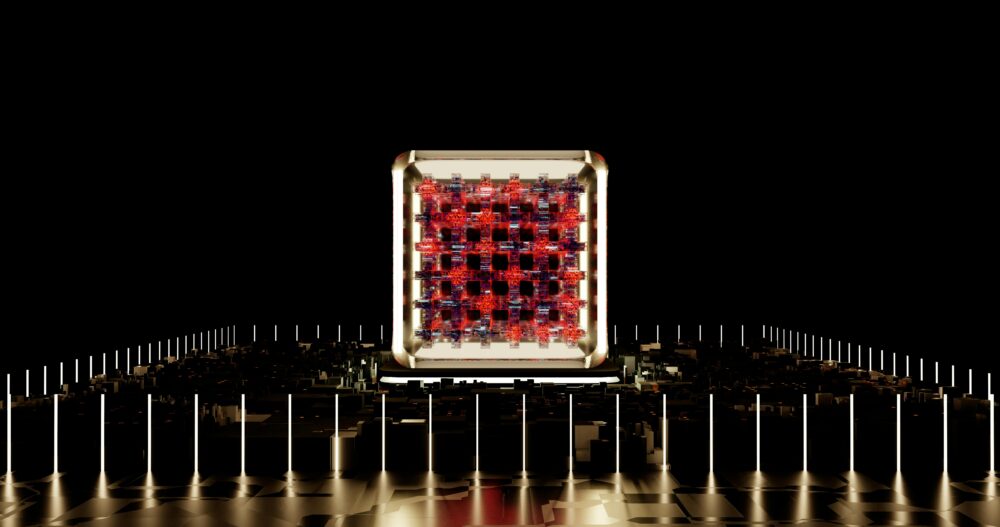
The fusion of artificial intelligence and quantum computing promises to solve complex problems in timeframes impossible for classical computers. An emerging technology that could transform sectors from energy to medicine.
Quantum artificial intelligence represents one of the most promising and revolutionary frontiers of modern technology. This emerging discipline combines the principles of quantum mechanics with machine learning algorithms, opening computational possibilities that were considered science fiction until recently.
The Foundations of Quantum AI
While classical computers process information using bits that can only be 0 or 1, quantum computers use qubits that can exist in multiple states simultaneously thanks to the phenomenon of quantum superposition. This characteristic, combined with quantum entanglement, allows calculations to be performed in parallel on exponential scales.
In the context of artificial intelligence, this translates into the ability to explore vast solution spaces in dramatically reduced times. Machine learning algorithms that would require years on traditional supercomputers could be executed in hours or days.
Revolutionary Applications on the Horizon
- Drug discovery: Quantum simulation of complex molecules will accelerate the development of new medicines
- Logistics optimization: Solving previously intractable routing and supply chain problems
- Cryptography: Development of unbreakable quantum security systems
- Climate modeling: Weather and climate predictions with unprecedented precision
- Artificial general intelligence: Acceleration toward more sophisticated and autonomous AI systems
Current Challenges
Despite extraordinary promises, Quantum AI still faces significant technical challenges. Quantum systems are extremely sensitive to environmental interference, requiring operating conditions near absolute zero. Quantum decoherence limits available computation time, while quantum error correction remains a complex problem.
Furthermore, developing efficient quantum algorithms requires deep understanding of both quantum mechanics and machine learning, creating a significant skill barrier for many researchers.
The Protagonists of the Quantum Revolution
Tech giants like IBM, Google, Microsoft, and Amazon are investing billions in developing quantum AI platforms. IBM has launched the Quantum Network, while Google achieved “quantum supremacy” with its Sycamore processor. Innovative startups like Rigetti Computing and IonQ are pushing the boundaries of accessible quantum technology.
Toward a Quantum Future
Experts predict that within the next decade we will witness the first commercial use cases of Quantum AI. Sectors such as quantitative finance, energy optimization, and pharmaceutical research will likely be the first beneficiaries of this technological revolution.
Quantum AI will not completely replace classical artificial intelligence but will create a hybrid ecosystem where specific problems can be solved with the most effective approach. This synergy promises to accelerate scientific and technological progress in ways we are only beginning to imagine.